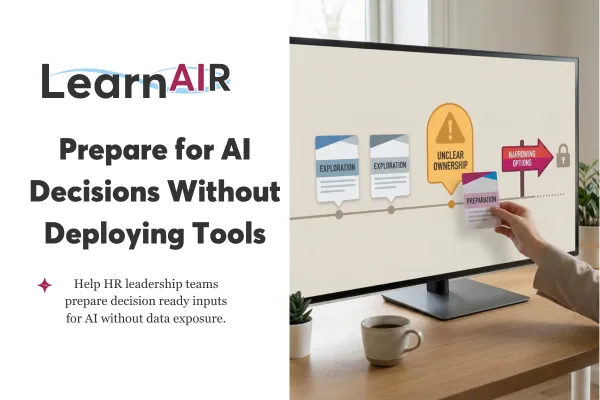
Prepare for AI Decisions Before They Become Irreversible
A governance first checklist for CHROs who need clarity on risk, ownership, and boundaries.
The Solution Your Team Can Use Now
Mandatory Stop Conditions That Protect the Organization
How to Use the Preparation Checklist Across Your Organization
What Good Preparation Looks Like
The Decision You Can Make With Confidence
Benefits for You and Your HR Team

You are asked to move fast on AI. You are also asked to keep people, data, and the business safe. Both expectations exist at the same time. For many CHROs, this pressure is familiar.
Over the past year, many organizations explored AI in practical ways. Tools were tested. Early pilots appeared. In some cases, value surfaced quickly. What often followed was not resistance to AI, but a pause driven by experience. Leaders recognized that moving forward again required clearer inputs, stronger ownership, and better decision discipline than before.
For a CHRO, the early decision is rarely about a specific tool. It is about whether the organization has enough decision-ready information to evaluate AI safely. That information comes from preparation. Preparation is the work that allows leadership to say yes, no, or not yet with confidence.
AI readiness does not begin with execution. It begins with preparation.
Why preparation matters:

As the executive owner of people, policy, and trust, you face specific risks when AI interest spikes across the business.
Shadow experimentation often appears after early exploration. Small pilots emerge in pockets, not out of defiance, but out of momentum. You inherit the risk after activity has already started.
Real employee or candidate data may be handled informally. Even well-intentioned testing can raise concerns around privacy, compliance, and employee trust.
Ownership can feel diffuse. Questions arise about who approves changes, who is accountable for outcomes, and where escalation should occur if something goes wrong.
Meetings multiply without moving the organization closer to a defensible decision. Conversations generate ideas, but not clarity.
Curiosity can quietly cross into production. The line between exploring possibilities and changing how work is done becomes harder to enforce without shared guardrails.
These challenges are not signs of poor leadership. They are predictable patterns that emerge when interest moves faster than decision structure.
The Solution Your Team Can Use Now
A preparation checklist gives you a structured way to collect the information leadership needs without using tools, uploading data, or changing workflows. It keeps the organization in a preparation posture and stops activity the moment it begins to look like implementation.
What the checklist is.
It clarifies one existing HR workflow at a time. It names the purpose, the inputs, the steps, and the outputs.
It surfaces data sensitivity, risk, and governance considerations. It documents what is known and flags what is not known.
It prepares focused questions for leadership review. It frames the decision without recommending tools or solutions.
What the checklist is not.
It does not recommend or use AI tools. It does not create prompts or automations.
It does not test workflows or upload documents. It does not change how work is done.
Completion means preparation, not readiness.

Mandatory Stop Conditions That Protect the Organization
The checklist instructs teams to stop and escalate if a tool is involved, if real employee or candidate data is involved, if approval or ownership is unclear, if Legal or IT involvement is uncertain, or if the work starts to feel like execution. When in doubt, the right action is to stop. Escalation brings the conversation back to governance and executive ownership.
How to Use the Checklist Across Your Organization
Focus on one workflow only. Describe the current state as it exists today. Write as if you will read it yourself. Encourage teams to document uncertainty rather than resolve it on the spot. The checklist is complete when leadership can clearly decide yes, no, or not yet.
What Good Preparation Looks Like

Good preparation is simple to consume and easy to audit. The package you receive should include the following.
A clear workflow description with purpose, frequency, owners, and recipients.
A current state summary that lists inputs, human steps, outputs, and known friction points.
A data sensitivity scan that labels information as public, internal, employee, compensation, performance, health, or unknown.
A concise risk list that names privacy, fairness, compliance, policy, and trust implications without solving them.
A stakeholder map that lists who must review or approve any future change, including HR leadership, IT, Security, Legal, Compliance, and any councils.
An authority check that confirms the executive owner, the approver for changes, and the accountable role if something goes wrong.
A boundary list for what must stay human, including judgment calls, sensitive communication, policy interpretation, and manager or employee decisions.
A short set of questions for leadership that frames suitability, guardrails, data boundaries, and stop conditions.
The Decision You Can Make With Confidence
When a team completes this preparation, no tools were used and no data was uploaded. Risks are surfaced and ownership is clear. At that point, you can pause and escalate for an executive decision. If you choose to proceed, these materials can inform a governed initiative. If you choose to stop, that outcome is valid and complete. Your role is not to move fast. Your role is to make the decision safe.

Benefits for You and Your HR Team
For CHROs
You gain a consistent, decision‑ready package that is written for executive review. You can evaluate value, risk, and readiness without endorsing tools or pilots.
You strengthen governance by enforcing clear stop conditions and clear ownership. You protect trust with employees and peers.
You reduce rework and meeting churn by focusing the conversation on what matters. You get a simple way to compare workflows side by side.
For HR Teams
Teams know exactly what to document and what to avoid. They save time by using a single structure for preparation.
Teams can separate curiosity from production. They keep exploration safe and non‑operational.
Teams align faster with IT, Security, and Legal because the inputs are clear and non‑technical.

Your Next Step
To make preparation easy to start, we created a public, checklist for HR practitioners. It exists to help your teams prepare decisions‑ready inputs so you can lead a safe and informed choice about AI.
Get the AI‑Readiness Preparation Checklist

Human-first. AI-ready.