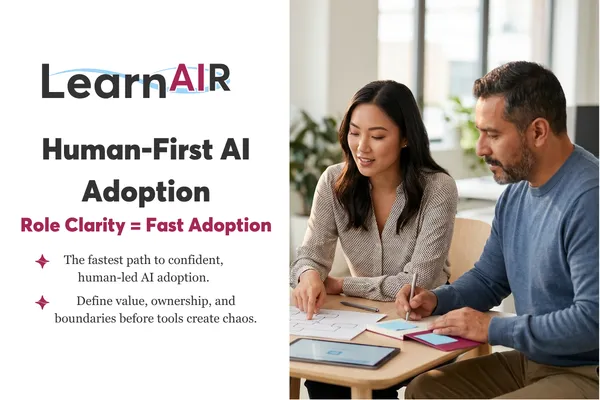
Redefine the Human Role First (Before You Build an AI Agent)

Redefine the Human Role First (Before You Build an AI Agent)
Why AI rollouts trigger resistance when the human role stays vague
Why role redesign should come before agent design
What employees need to feel before they will own AI transformation
The new human job after AI enters the workflow
Human work that increases when routine work shrinks
How to run an AI-first role rewrite exercise with your team (45–90 minutes)
Step 1 — Map the work (current state)
Step 2 — Tag what AI can handle vs what humans must own
Step 3 — Define new “human-owned outcomes”
Step 4 — Add guardrails (to reduce fear + risk)
Step 5 — Define success metrics (simple, measurable)
Manager mistakes that make AI feel like a threat
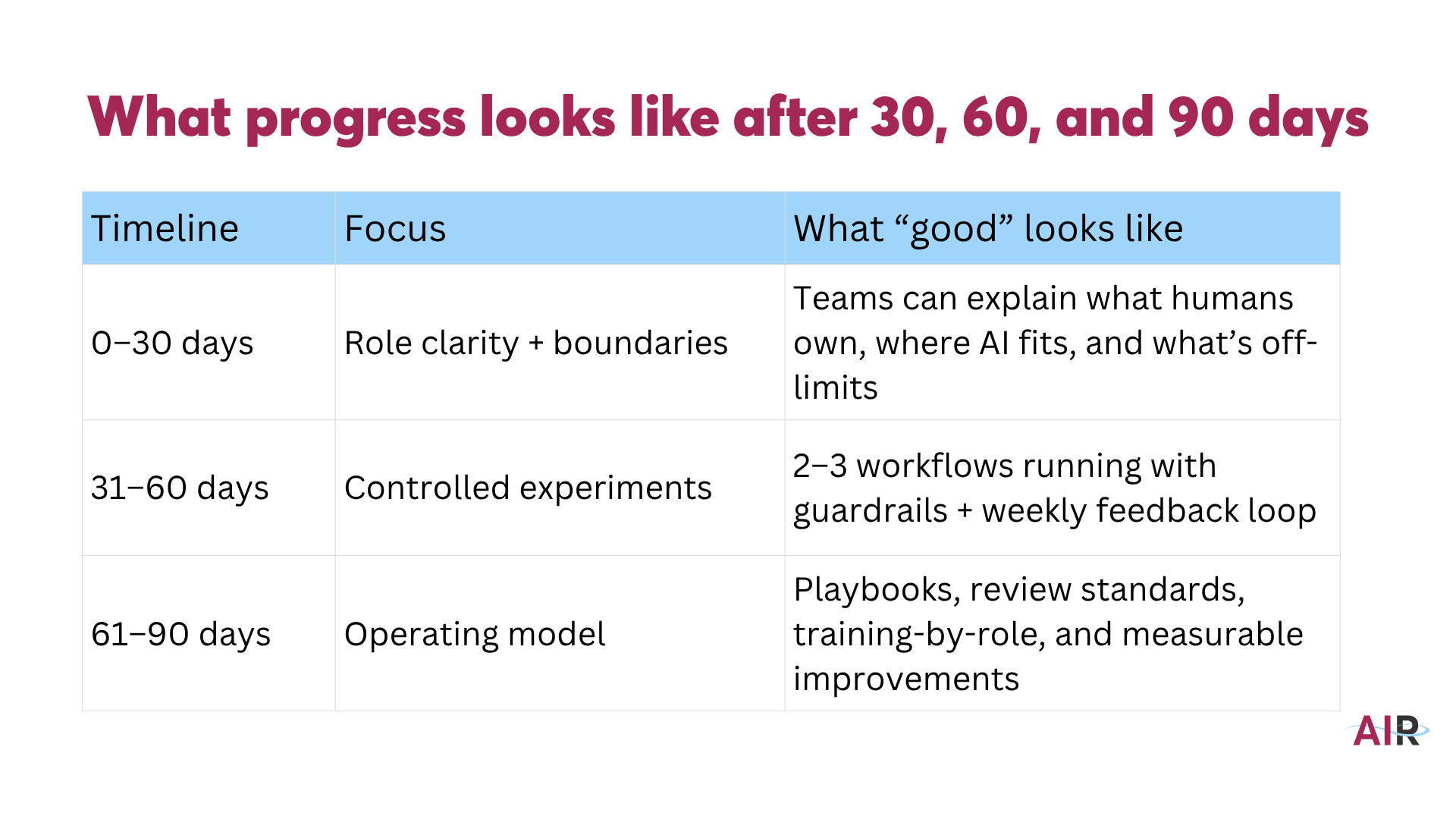
What progress looks like after 30, 60, and 90 days
TL;DR
AI adoption fails when people can’t answer: “What will still count as my value?”
The better sequence is Role Redesign → Bounded AI Use → Measure + Scale (not “tool first”).
If you want faster adoption, start by defining what humans will own: judgment, exceptions, priorities, trust, accountability.
Why AI rollouts trigger resistance when the human role stays vague
Most organizations treat AI as a tooling problem (“here’s Copilot, go use it”). People experience it as an identity + reward problem:
Identity: “If AI drafts it, what’s my job now?”
Ownership: “What decisions am I still responsible for?”
Reward: “Will I get less credit if I use AI?”
What this means for leaders:
Resistance is often a rational response to unclear expectations, not “bad mindset.”
Why role redesign should come before agent design
The strongest, research-backed version of this idea isn’t “AI replaces jobs overnight.” It’s:
AI is changing the mix of tasks, judgment calls, and coordination inside jobs so people need a new definition of high-value human work before you introduce agents.
Practical translation:
If you roll out agents first, you trigger fear + confusion.
If you redesign roles first, you trigger clarity + ownership.
What employees need to feel before they will own AI transformation
A simple way to predict adoption: do people feel choice, capability, and trust?
This maps directly to the doc’s motivation foundation (Self-Determination Theory):
Autonomy: “I have a say in how my job changes.”
Competence: “I can do this confidently.”
Relatedness: “My manager and team have my back.”
Leadership behavior that improves adoption:
Take employee perspectives seriously
Offer meaningful choices and input
Encourage self-initiation (not “forced compliance”
The new human job after AI enters the workflow
AI is great at abundance work (speed, drafts, idea volume, 24/7 availability). Humans should own decision work.
Human work that increases when routine work shrinks
Judgment and tradeoffs
Exception handling (“this case is different”)
Prioritization and escalation
Stakeholder communication + alignment
Ethics and risk decisions
Coaching and quality control
Trust and accountability
The mental model:
AI drafts. Humans decide.
AI suggests. Humans own the outcome.
How to run an AI-first role rewrite exercise with your team (45–90 minutes)
Use this as a workshop agenda or leadership exercise.
Step 1 — Map the work (current state)
List the top 10–15 recurring tasks in the role
Mark tasks that are:
Repetitive
Information-heavy
High-volume
Low-risk
Step 2 — Tag what AI can handle vs what humans must own
Create 3 buckets:
AI can draft/assist
Human must decide
Human must approve + be accountable
Step 3 — Define new “human-owned outcomes”
Examples:
“I own the final decision + stakeholder alignment”
“I own exceptions, edge cases, and risk calls”
“I own quality standards and review checks”
Step 4 — Add guardrails (to reduce fear + risk)
What AI must not do
What data AI must not use
What requires human approval
What must be documented (audit trail)
Step 5 — Define success metrics (simple, measurable)
Pick 2–3:
Cycle time reduced
Fewer errors / rework
Higher quality score
Adoption rate (weekly)
Manager confidence rating
Manager mistakes that make AI feel like a threat
These are the adoption killers:
Rolling out tools before clarifying role changes
Measuring only speed (and ignoring judgment + outcomes)
Rewarding output, but not decision quality
No governance, no boundaries, no training
Treating AI like a “silent shortcut” instead of a visible workflow upgrade
Fix: Role-specific enablement + clear guardrails beats generic “AI training.”
What progress looks like
This matches LearnAIR™’s preference for showing a journey over time (month-by-month trajectory builds confidence).
Ready to empower your executive team?
Book a quick discovery call and we’ll map one role together.
"I just think these tools are incredible and Justin does a fantastic job delivering the content in a very relatable and easy to apply manner.
Honestly I think that everything shared is going to make a huge impact to our team and our work if we can get the approval to use them. The possibilities of using digital assistants in addition to other AI tools like NotebookLM and HeyGen are mind blowing.” — Anonymous | Les Schwab
Frequently Asked Questions
How do you prepare employees for AI agents without causing resistance?
Start with role clarity: what changes, what stays human, how value is recognized.How should managers redesign roles for an AI-first workplace?
Map tasks → bucket AI vs human decisions → define ownership → add guardrails → set metrics.What is the human role when AI automates routine work?
Humans own decision work: judgment, exceptions, priorities, accountability.
Why do AI rollouts fail even when the tools are good?
Because adoption is a motivation + role design problem, not just access to software.What is an “AI-first role redesign workshop”?
A structured session that rewrites roles around AI so teams adopt faster with less fear and more clarity.
Book a quick discovery call and we’ll map one role together.
“Continue to learn more about the ChatGPT Agent feature and how to make ChatGPT do work for you
Justin is phenomenal to work with
Honing in on the exact instructions for my 'Digital Colleague'”
— Aiden Koistinen | Reveille and Retreat

Human-first. AI-ready.