Build Visibility and Quality in AI Use | HR Readiness
Why Training Fails without Readiness?
HR teams see uneven AI results and limited visibility. An assessment establishes a shared starting point, builds confidence, and focuses enablement where it will work.
The visible pain point leaders cannot ignore
Why training alone does not resolve this problem
Why assessment must come before action
What the AI Readiness Assessment provides
The value for leaders and teams
Why this matters:

For most of the past several decades, enterprise technology told people what to do. Systems enforced rules, constrained choices, and standardized output. Training worked because the organization itself reinforced consistency.
AI changes this dynamic. For the first time, technology has gone from human transaction with the software to human direction of the software. It responds to intent, judgment, and context. Organizations were not designed for this kind of technology, and most operating models still assume tools will produce uniform outcomes.
This mismatch sits at the center of today’s AI adoption challenges.
The Visible Pain Point Leaders Cannot Ignore
Across organizations, leaders are seeing the same pattern emerge.


AI-assisted outputs vary widely in quality and reliability.
Leaders lack visibility into how AI is being used across teams.
Managers struggle to distinguish strong AI-supported work from weak or risky usage.
The result is growing unease. Adoption is happening, but it is uneven and difficult to govern. Confidence erodes not because AI lacks potential, but because its use is opaque.
Why training alone does not resolve this problem

Training increases exposure to tools and techniques, but it does not create consistency. When AI reflects individual thinking styles, outputs will naturally diverge unless the organization provides shared standards, guardrails, and expectations.
Without readiness, training amplifies variance. High-confidence users move fast. Others hesitate. Managers review work subjectively. Leaders see activity without clarity.
This is not a skills failure. It is an enablement gap.
Why assessment must come before action

Before organizations act, they need a shared understanding of where they stand. An assessment creates a neutral starting point. It replaces assumptions with evidence and reduces both hype and fear.
People are far more willing to engage when they understand their current state. Leaders gain confidence because conversations shift from opinion to data. Teams align around reality rather than aspiration.
Assessment is not about judgment. It is about orientation.
Why take the AI Literacy Assessment
Get clarity. Replace assumptions with a shared baseline of current literacy, fluency, and safe-use so conversations shift from opinion to evidence.
See what to do next. Turn the baseline into a focused training path so skills land in real workflows instead of staying in a classroom.
Make usage visible. Reveal where AI is working well and where quality is fragile so managers can coach to a clear standard.
Reduce hype and fear. Give teams a neutral starting point that increases confidence to practice and improves consistency across functions.
Invest where readiness exists. Stop guessing. Prioritize the two workflows that will deliver reliable gains in weeks, not quarters.
What the AI Readiness Assessment provides

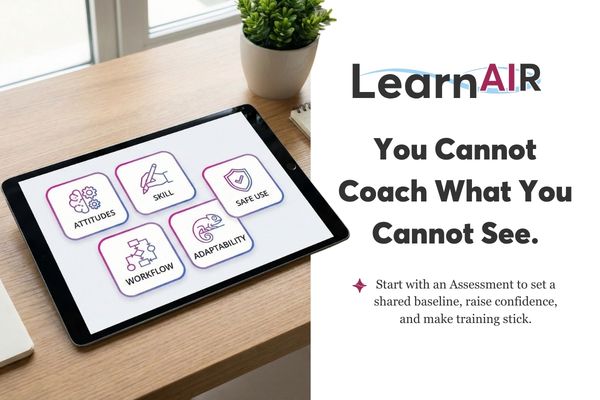
The AI Literacy Assessment quantifies how AI is currently being used across the organization. It measures core dimensions of fluency, including attitudes toward AI, practical skill, safe use, workflow integration, and adaptive capability.
The output is a clear, objective view of readiness that leaders can trust. It enables informed discussion without exaggeration or alarmism.
What you receive:
A concise readiness score with banding and a plain-English interpretation.
A heatmap across key dimensions like skill, safe-use, and workflow integration so variation is easy to spot.
A 30–60 day training path tailored to your baseline, including two recommended workflows to standardize first.
Manager enablement assets such as a five-minute review rubric and a clear Definition of Done.
The leading indicators to track weekly like time to first draft and rework percentage.
The assessment gives you a clear, objective view of how AI is used today and a training path your managers can run tomorrow.
The Value for Leaders and Teams
With a shared baseline, organizations gain:

Clarity on where AI use is effective and where it is fragile.
Visibility into variation across teams and functions.
A common language to discuss AI needs without hype or fear.
Confidence to sequence investments rather than rushing prematurely.
Consistency replaces randomness through digital teammate blueprints, SOP-level instructions, and named task starters.
Quality becomes reviewable with standard outputs and simple human-in-the-loop checks.
Confidence rises when frameworks and practice are structured.
Most importantly, leaders stop guessing where to focus.
30–60 day plan

Run the AI Readiness Assessment to baseline literacy, fluency, and safe-use.
Select two HR workflows with high repetition such as onboarding or policy digestion.
Build a digital teammate for each with role, SOP, reference library, and task starters.
Enable managers with a five-minute review rubric and a clear Definition of Done.
Track time to first draft, rework rate, and guardrail adherence weekly.
Fast wins HR can Sponsor

Governance that creates visibility

Require org-approved accounts and limit knowledge sources to the approved reference library.
Define “ask before acting” moments and escalation paths for sensitive decisions.
Keep task starters and outputs standardized so usage remains auditable.
Your Next Step
When readiness is established, AI adoption becomes deliberate rather than reactive. Organizations focus enablement where it can succeed and avoid investing in initiatives that are not yet prepared.
Over time, outputs become more consistent. The readiness enables managers review with confidence. Leaders gain visibility without surveillance. AI shifts from a source of uncertainty to a governed, human-centered capability.
Training then accelerates impact because the organization is ready to absorb it.
AI Literacy Assessment
Take the AI Literacy Assessment. Get your baseline and plan next steps.

Human-first. AI-ready.